Tuesday, December 12, 2017

Margin of Safety 3

This version of Margin of Safety sought to solve three problems: 1) reduce thickness of front armor, to extend blade reach, 2) make the belt drive less annoying and more reliable, and 3) use brushed motors again.
Final render.
The holes make it faster.
Machining progress shot.
Bandsawing UHMW with the wrong type of blade.
To reduce the thickness of the front armor the hub motor holder was redesigned yet again. This time I went for a spline shape instead of fish shape.

The spline teeth prevent rotation and provide strength around the screw holes. The inverse teeth from the plastic are clamped between a bottom flange that is integrated in the holder and a top flange that is clamped on with screws. The screws also hold the main hub bearing in. This way the plastic is clamped between metal pieces with a hard endstop, so the plastic can deform if it needs to without compromising the overall structure.
Spline assembly assembled with bearing.
It is one of my prouder designs. The same spline assembly is still used after four events, with nothing more than scuffs.

The drive axle bearings were clamped between two T shaped pieces of aluminum. The aluminum then clamps onto the plastic with screws running through to keep it in place.
Each half had a flange only on one side, to make it easily machined.
The idea was the foam wheels and soft plastic body would allow me to get away with cantilevered drive wheels. This assumption was false, however it did limit deformations before they affected drive performance. It was also successful in decoupling the side armor from the drive axles.
Fourteen half-inch holes were drilled because I used slightly thicker aluminum plates than what I modeled.
This board is called Calabash.
A new control board was made, using TI's DRV8821 current limiting brushed motor drivers, Allegro A4960 brushless controller, STM32F3 microcontroller, and L3GD20 digital gyro. This is to support using a bunch of 13 mm diameter Maxon gear motors I got off eBay. The motors did great, until I burned out the brushes due to overvolting them from 12 V to 24 V. Luckily they made audible noise before failure, so they could be preemptively replaced.
Showing packaging of motors, batteries, and electronics.
This robot won first place at Sparkfun AVC 2016, but not before breaking every weapon disk I had on hand.
All the pieces.

Monday, December 11, 2017

Welding Practice Kart

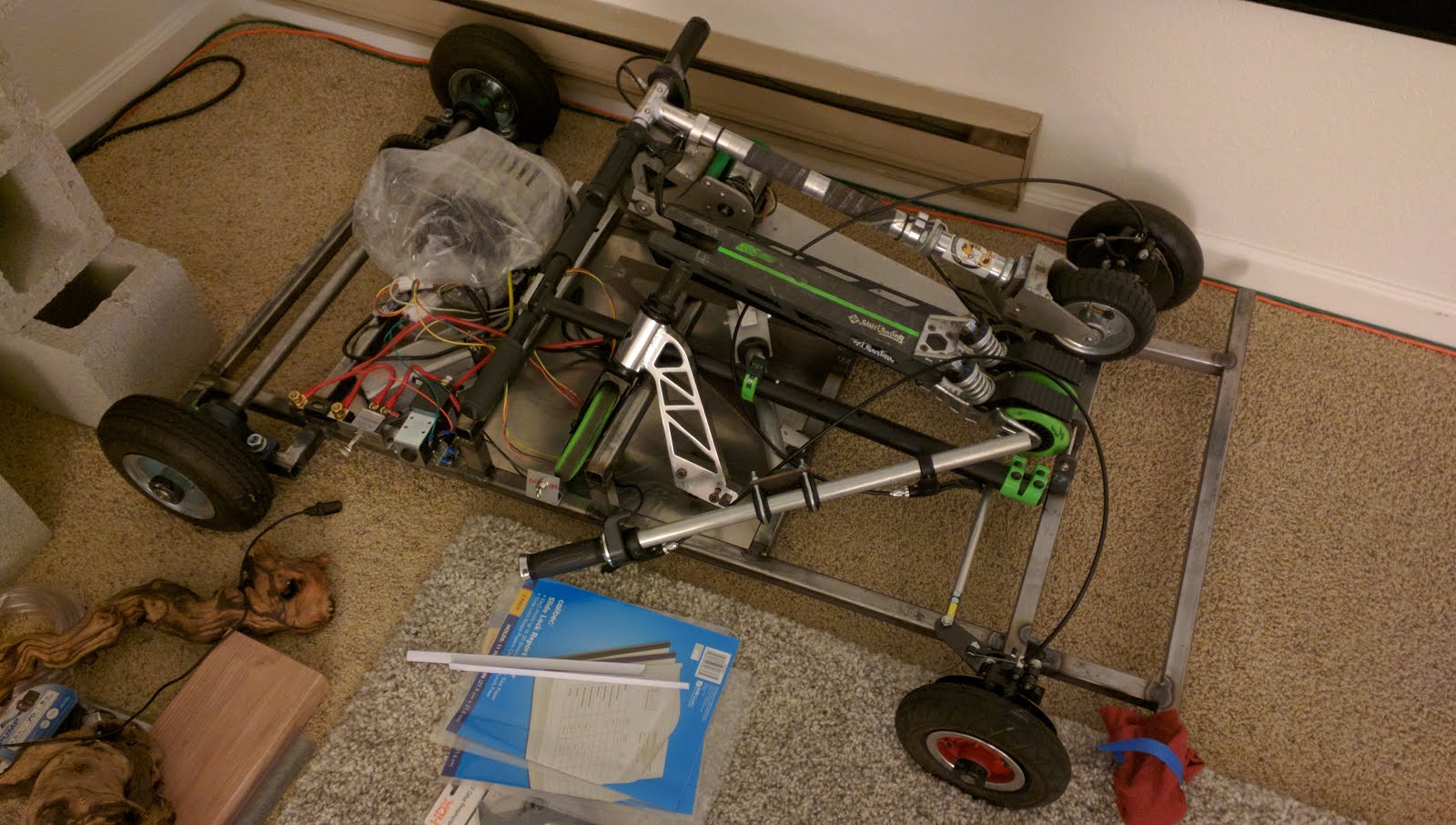
This is a simple electric go kart I decided to build in 2015-2016 because I wanted welding practice. There isn't too much work done into car kinematics, since even a sloppy driving go kart is fun. The external dimensions are constrained by what fits in the trunk of my car after mind disassembly. The kart went from design to finished over the course of eight months working on and off.
Final CAD model
Trying to work out how long to make it.
I used a comically oversized brushless motor (Motenergy ME4201) with a very capable motor controller (Kelly KLS7218S), then connected it to three low current (but high capacity) batteries (14 V, 47 A-h lithium ion). The batteries were free, so there's that. 
Test fitting frame pieces. All made of 1/8" wall 1" square tube for ease of fabrication.
Making steering knuckles.
First welds. Because I'm a masochist I decided to TIG everything.
Seat and motor mount.
Steering knuckles and brake disks.
Rolling chassis.
Pretty alright welds.
Welds that could use some work.
Rolling with steering.
Wiring done. Crimped connections are so nice.
Done. Note the individually controlled front brakes. If you're a hotshot you can do brake vectoring.
Flat packed so it can barely fit in my car


Margin of Safety 2

Margin of Safety 2 sought to improve on two things: 1) The center of balance, and 2) vulnerable front end. To fix the center of balance, it was designed with a belt drive to move the drive wheels forward.
Belt drive visible next to the drive wheels.
The belt drive worked wonders in getting mass over the wheels but was exceedingly tricky to design and assembly. The belts had no tension adjustment, so over time they would stretch slightly and have to be replaced. The drive wheel axles had to be inserted from the outside of the robot through the side armor, requiring a hole and introducing a weak spot. When the belt needed to be changed the axles had to be removed through the same hole, requiring patient shaking and strong magnets.
Side view showing the recessed position of the drive axles. I miss how good this robot looked with its sloped armor and chamfers.
Luckily there were no hits that cut through the side armor, although one came close.
A hit right on the axle hole. Luckily there is a bronze bushing holding the axle and preventing plastic deformation from binding the axle.
The second improvement is sloped armor. I had bought a chamfer mill and made sure to use it everywhere.
Only three stepdowns because I had to trick my CAM software into doing mild surfacing.
Unfortunately hits to the front are rare so I was not able to test how well it deflected impacts.

The circuit board was spun to fix the drive reset issue. 
Shown with shock absorbing polyurethane foam.
Finally, a new weapon holder was designed. It kept the overall fish shape.

The robot won Motorama 2016 despite shattering a blade in the final. Since the shatter was asymmetric it was able to continue using the remaining pieces, with significant vibrations.

To mitigate this blade breaking issue an extra fat blade was made for Robogames 2016
Shown here with fellow competitor Best Korea.
It lost after a couple matches due to the brushless motors destroying the silver spark gearboxes. It was a familiar sight, seeing my robot get slower and slower with every impact until control is lost.

Here it is with all the pieces laid out nice. No issues with the weapon's hub motor, which was nice.

Thursday, June 1, 2017

Toyota 1984 22R-E Vacuum Line Diagram

22R-E emissions vacuum line routing, 1984 model.
Click to enlarge.
This is the emissions vacuum line diagram for the 22R-E engine. This particular year, 1984, has slightly different components than previous years, but is also not quite the fully redesigned 22R-E of later years, which have only three ports on the intake body. One easy way to tell is the 1984 model has only one bimetallic vacuum switching valve (BVSV), located on the intake manifold under a coolant hose. Earlier years have two BVSV valves. The vacuum transmitting valve (VTV) is likely the same flow rate as previous valves, that is type BROWN (400 cc/min). It opens to atmosphere.

Thursday, March 9, 2017

Margin of Safety Version 1

Lets fix the problem with the weapon bearing coming out. Put the bearing in an aluminum holder that maintains dimensions, and put that against the plastic to keep the same degree of shock mounting.

The bearing is held in with M4 flanged button screws. Eight of them.

It slots into the frame.
The robot uses the same dimension blades as before.
Blade down
It's flat.
Finally, this robot uses 12 mm brushless motors connected to Silver Spark 22:1 gearboxes for the drive. To control them, I made my own triple brushless control board. It's based on the STM32F3 and Allegro A4960. It was squirrelly and hard to drive, despite gyro correction in the controller.

I'm not perfect.
It then competed at Dragoncon 2015, winning first place, and a local event SLAW, also winning first place. Post event pictures follow.
Still together

Evidence of the blade pushed into the frame, but this is anticipated.

Tip is a little worn.

I fought a robot with large wheels that could crawl over this robot (though that's not hard). It was equipped with a vertical bar that hit from above.

A few knicks in the back.

Went face to face with a drum. Not bad.

The brushless motors run super hot. To solve this, I bought thick heat conductive padding for the motors. It worked great, even though the conductive padding is more rigid than the standard polyurethane rubber.

Both sides.

Brushless motors stuck on a silver spark.

Pinion appears alright?
Hub motor.


I actually go on to use this hub on quite a few other bots.

Good condition.

Stator fine.

The pieces.